

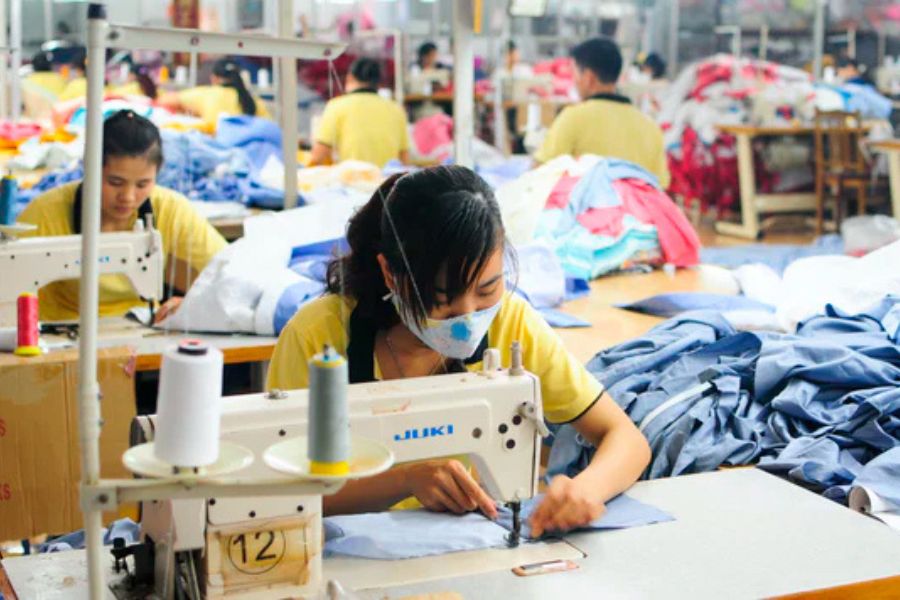
Most textile production before the Industrial Revolution was a labour-intensive process, normally by individuals in their own homes using basic tools and equipment; people spunk and wove cloth by hand, often in the making of garments or fabrics for personal use or local trade. The Industrial Revolution dramatically changed this system. By the end of the period, textile manufacturing had become a large-scale industry, with most of the production taken over by factories.
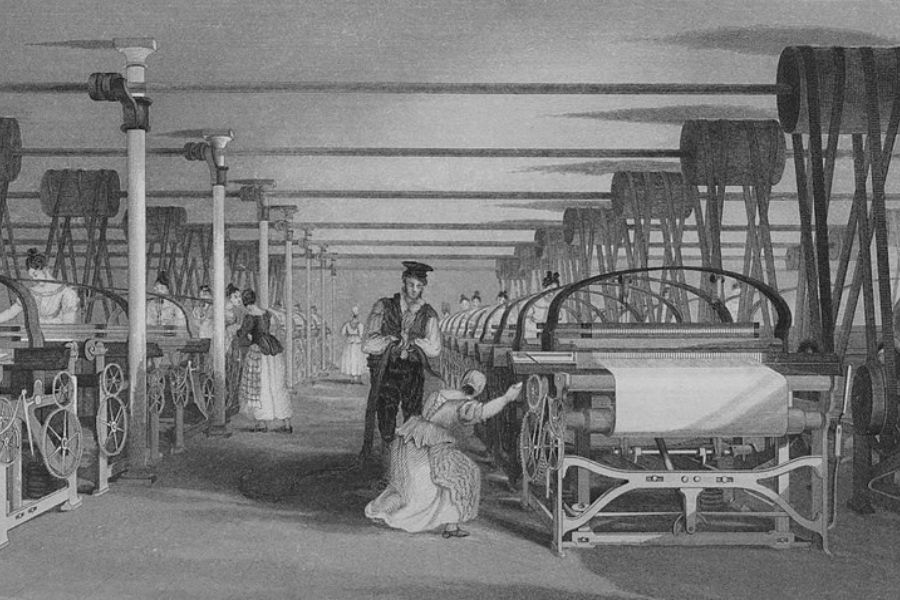
During this period of great technological and social change in Britain, complicated machinery such as power looms and spinning jennies, powered by steam engines and water wheels, began to be developed. This shift from home-based production to factory-based manufacturing was the catalyst that catapulted the textile industry into the UK being a global leader in the trade of fabrics. Companies such as T & A hosiery and textile manufacturers joined this surge, creating one of the fastest periods of growth in textile factories and mass availability of fabrics globally.
The Factory System
These technological changes quickly revolutionised textile production under the factory system. While it offered the advantages of speedier, cheaper, and more regular production, it also had large social consequences. Workers are separated from the means of production and placed under control, whereas previously they were themselves masters of the means. It was also a turning point from the cottage model in which production moved out from home-based work into centralised, mechanised factories.
Growth of Factories
The growth of mechanised factories was most apparent in the cotton and wool industries. A number of people attribute Richard Arkwright as the originator of the modern factory system. Following his patent on the water frame in 1769, Arkwright built Cromford Mill in Derbyshire, England and expanded the nearby village to house the migrant workers that were needed. Large technological advantages enabled the early 19th-century mechanised factory to outcompete the craft shops in every respect. The factory system would soon extend to shoemaking, machine making, and agricultural implements as well.
Pre-Industrial Textile Industry
In the early 18th century, the British government passed the Calico Acts to protect the domestic wool industry from the increasing imports of cotton fabrics from India. Textile production in Britain at that time was slow and labour-intensive. Spinning and weaving were typically done within households for domestic use or as part of a cottage industry. Sometimes, work was done in the shops of skilled master weavers. Under the putting-out system, homeworkers produced under contract with merchant sellers who often supplied raw materials. In the off-season, women-usually farmers’ wives-would do the spinning, while men did the weaving. It took anywhere from four to eight spinners working with spinning wheels to supply one handloom weaver.
Industrial Revolution and Textiles
The Industrial Revolution formed the most critical moment of the development of the textile industry, further catalysing the technological changes. The steam engine substantially increased demand for coal and therefore evoked growth of the iron industry. When the industries needed to be provided with raw materials by efficient transport means besides exporting the finished products, the expansion of the canal system was followed by the coming of railways after 1830. The introduction of steam power along with the water wheels and mechanical devices increased the production capacities to an unparalleled extent. Moreover, the making of all-metal machine tools in the early 19th century could produce more machines for other industries. This wave of industrial progress cut across Western Europe and North America in the 19th century and, in a relatively short period thereafter, encompassed most regions of the world.
Early Developments
As early as the late 17th century, the East India Company opened factories in South Asia to produce cotton fabrics in large volumes for the UK market. These imports-cotton calico and chintz fabrics-started to aggressively compete with wool and linen textiles traditionally processed within Britain. Locals employed in trades such as weaving and spinning, and even farmers urged the ban of imported cotton textiles, because of which Parliament approved the 1700 and 1721 Calico Acts. These imposed a ban on the import of finished cotton textiles while raw cotton was permitted to be imported along with home manufacture of fustian cloth manufactured from flax combined with cotton.
Mechanisation of the Textile Industry
Key inventions like Cartwright’s loom, the spinning mule, and Boulton and Watt’s steam engine set in motion the beginnings of a mechanised textile industry. Technological innovation in the machinery itself now becomes the industry’s focus, with owners of mills trying constantly to cut costs further and/or improve production quality. Developments in transportation, especially the canal and rail systems, were important to the importation of raw materials and the export of finished fabrics.
Export Technology
As Britain was increasingly dominating the production of textiles, it became protective of its technology. Engineers who knew how to build textile mills and machinery were forbidden to emigrate, especially to the United States. However, one engineer, Samuel Slater, had worked with Arkwright’s partner, Jedediah Strutt, and emigrated secretly to New England in 1789. He soon reproduced the textile mills that were critical to America’s industrial revolution. In 1793 Eli Whitney invented the cotton gin, a machine that dramatically speed up the process of separating cotton seeds, greatly increasing efficiency over fiftyfold.
Keep visiting umuhuzanews for more informative blogs.
