

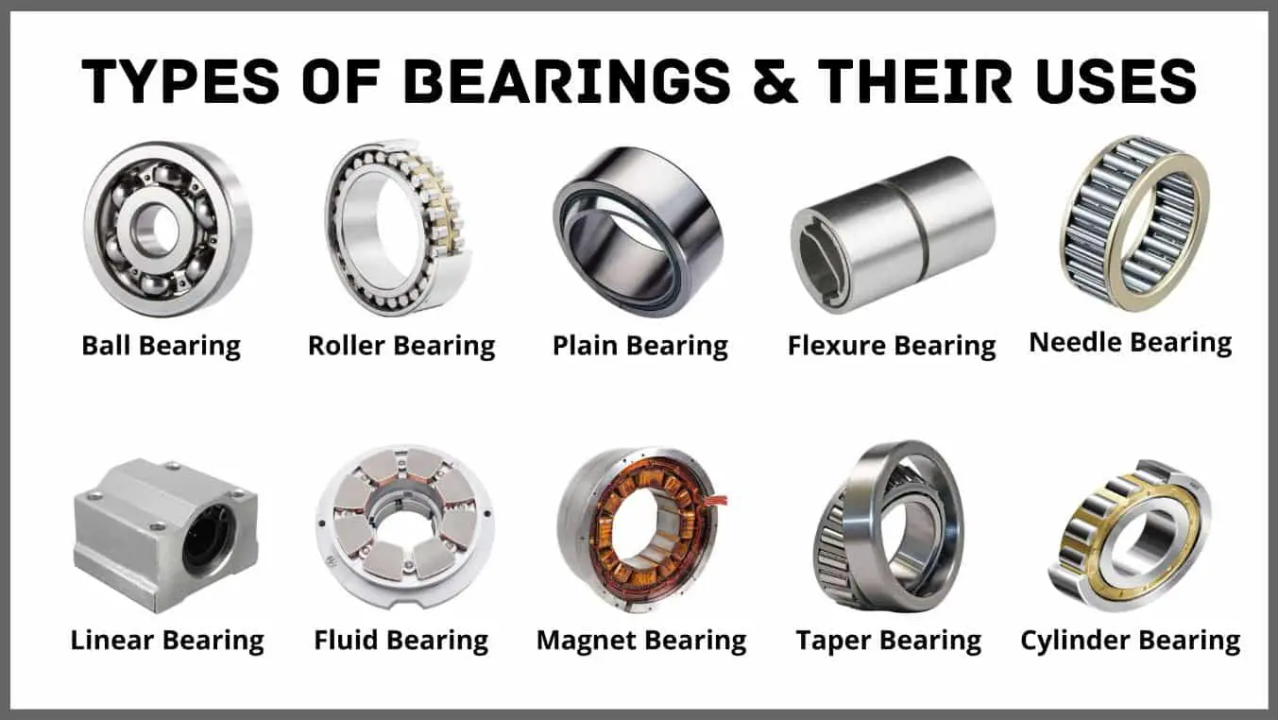
Bearings are mechanical components that facilitate the smooth and efficient movement of machines by reducing friction and wear. They play a crucial role in almost every rotating or moving part of machinery, from automobiles to industrial equipment, electric motors, and even everyday appliances. Bearings come in a variety of designs, materials, and sizes, each tailored to specific applications and operational requirements. Understanding the different types of bearings and their characteristics is essential for selecting the right one for a given application.
In this article, we will explore the most common types of bearings, their features, advantages, and the industries where they are typically used.
What Are Bearings?
A bearing is a machine element designed to support and reduce the friction between two moving parts. It typically consists of a stationary outer ring, a rotating inner ring, and rolling elements such as balls or rollers that enable movement. The primary function of a bearing is to facilitate smooth motion by minimizing friction and providing support to the shaft, which is critical for efficient operation and the longevity of the equipment.
Bearings are used in a variety of settings, ranging from high-speed applications in aerospace and automotive industries to low-speed, heavy-load operations in industrial machinery. The type of bearing chosen for an application depends on factors such as load capacity, speed, precision, and environmental conditions.
Types of Bearings
There are many types of bearings, each designed for specific applications and performance requirements. Here, we will cover the most commonly used types of bearings, their characteristics, and where they are best utilized.
1. Ball Bearings
Ball bearings are one of the most widely used types of bearings. They consist of a set of spherical balls that roll between two rings (the inner and outer races). The balls are typically made of high-quality steel or ceramic, which allows them to reduce friction and handle radial and axial loads efficiently.
Advantages:
- Versatile and widely used in a variety of applications
- Smooth and low-friction operation
- Suitable for both radial and axial loads
Applications:
- Automotive wheels and hubs
- Electric motors
- Household appliances (e.g., fans, washing machines)
- Robotics and automation systems
Ball bearings are ideal for applications that require moderate load capacities and high rotational speeds, making them a popular choice in a wide range of industries.
2. Roller Bearings
Roller bearings use cylindrical rollers instead of balls to reduce friction between the inner and outer rings. These bearings can support heavier loads compared to ball bearings due to the larger surface area of the rollers. They come in several variations, including single-row, double-row, and tapered roller bearings.
Advantages:
- Higher load capacity than ball bearings
- Better suited for heavy-duty applications
- Can handle both radial and axial loads
Applications:
- Heavy-duty machinery (e.g., conveyors, crushers, mills)
- Automotive (e.g., transmissions, wheel hubs)
- Industrial applications (e.g., pumps, turbines, electric motors)
Roller bearings are commonly used in applications where high load capacity and durability are essential. The design of roller bearings makes them particularly effective in applications with heavy radial loads.
3. Needle Bearings
Needle bearings are a type of roller bearing that uses long, thin cylindrical rollers, resembling needles. They are typically used in applications where space is limited, and the load capacity is relatively high. Needle bearings are designed to support heavy radial loads and are commonly used in automotive and industrial applications.
Advantages:
- Compact and space-saving design
- High load capacity relative to size
- Ideal for applications where radial space is limited
Applications:
- Automotive engines (e.g., crankshafts, camshafts)
- Industrial machines (e.g., gearboxes, gear mechanisms)
- Agricultural machinery
Needle bearings are often used in automotive and industrial applications where there is a need for high load-bearing capacity in a compact design. Their ability to support significant radial loads in small spaces makes them particularly useful in tight and high-stress environments.
4. Tapered Roller Bearings
Tapered roller bearings feature conical rollers that allow them to handle both radial and axial loads. The design of the bearing means that the rollers and races are tapered, and the load is distributed across a larger surface area. These bearings are particularly effective at handling combined loads, which makes them ideal for high-load, high-speed applications.
Advantages:
- Ability to handle both radial and axial loads
- High load-carrying capacity
- Suitable for high-speed applications
Applications:
- Automotive wheel bearings
- Trucks and trailers
- Heavy machinery
- Gearboxes and transmissions
Tapered roller bearings are commonly found in automotive applications, especially in wheel hubs, where they must support both radial loads (from the weight of the vehicle) and axial loads (from the turning of the wheel).
5. Thrust Bearings
Thrust bearings are designed specifically to handle axial loads (force applied along the axis of the shaft). These bearings use rolling elements, such as balls or rollers, to reduce friction and provide support for axial loads. Thrust bearings are used in applications where the primary force is along the shaft rather than perpendicular to it.
Advantages:
- Designed to handle axial loads
- Reduces friction and wear in applications with axial forces
- High precision and durability
Applications:
- Automotive applications (e.g., clutches, transmissions)
- Marine engines
- High-precision equipment (e.g., pumps, turbines)
Thrust bearings are crucial in applications such as automotive transmissions and machinery where axial loads are prevalent, providing smooth, efficient operation while handling large forces along the shaft.
6. Spherical Bearings
Spherical bearings are designed to accommodate misalignment and angular movements between the inner and outer races. These bearings feature a spherical design, where the outer ring is shaped like a sphere, allowing the bearing to tolerate angular displacement. This makes spherical bearings ideal for applications involving rotation at varying angles or movements that cause misalignment.
Advantages:
- Can accommodate angular misalignment
- High load-carrying capacity
- Durable and resistant to wear
Applications:
- Construction machinery (e.g., excavators, cranes)
- Automotive suspension systems
- Agricultural equipment
Spherical bearings are commonly used in applications where misalignment or angular movement is present, providing the necessary support and flexibility to ensure the longevity of the machinery.
7. Fluid Bearings
Fluid bearings are a type of bearing that uses a thin film of liquid or gas to support the rotating parts. The fluid helps reduce friction between the moving components, providing a virtually frictionless operation. These bearings are often used in high-speed, high-precision applications where minimal wear and high performance are required.
Advantages:
- Frictionless operation, reducing wear and heat generation
- High precision and reliability
- Ideal for high-speed applications
Applications:
- High-speed turbines
- Spindle bearings in machining equipment
- Vacuum pumps
Fluid bearings are primarily used in high-precision, high-speed applications where conventional bearings might fail due to excessive friction or heat. Their ability to provide a frictionless interface makes them ideal for machinery requiring the utmost precision.
8. Magnetic Bearings
Magnetic bearings use magnetic fields to support the rotating parts, eliminating physical contact between the bearing surfaces. This type of bearing provides frictionless operation and is particularly useful in high-speed, high-precision applications where minimal wear and vibration are critical.
Advantages:
- Frictionless and wear-free operation
- Suitable for extremely high-speed applications
- Low maintenance
Applications:
- MRI machines
- Flywheels
- High-speed turbines
Magnetic bearings are highly advanced and are typically used in applications requiring frictionless movement, such as in certain medical devices or high-speed equipment.
Conclusion
Bearings are essential components in many machines and systems, ensuring smooth operation by reducing friction and wear. There are numerous types of bearings available, each with unique features suited to different applications. Whether you’re looking for a bearing to support high radial loads, handle axial forces, or provide high-speed, low-friction operation, selecting the right bearing type is crucial for the performance, reliability, and longevity of your equipment.
From ball bearings to magnetic bearings, each type has its own advantages and ideal use cases. By understanding the differences between each bearing type and their specific applications, engineers and machine designers can ensure they choose the best solution for their needs, resulting in optimized performance and reduced maintenance costs.
